Almustafa
The ProphetAlmustafa, the Prophet, is a visitor who has spent twelve years in Orphalese awaiting the ship that will carry him back to the isle of his birth. His decisive role in the narrative is both to speak and to depart: the ship’s arrival ends his long sojourn, while his final exchange with Almitra presents him not only as a voice heard by the people, but also as a listener among them.
Identity and the Long Wait
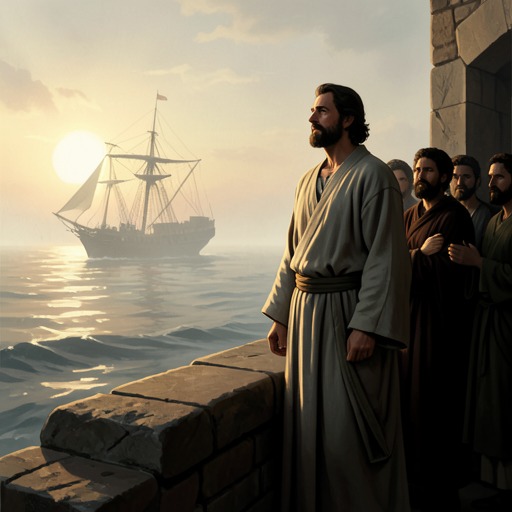
Almustafa is introduced as chosen and beloved, and as one who was a dawn onto his own day. The elevated description establishes a figure marked by spiritual significance, but his immediate circumstance is concrete: he has waited twelve years in Orphalese for a returning ship. Its purpose is not to take him toward an unknown destination; it is to bear him back to the isle of his birth. His time in the city is therefore framed by a departure anticipated from the beginning.
The waiting comes to its turning point in the twelfth year, on the seventh day of Ielool, identified as the month of reaping. Almustafa climbs a hill outside the city walls and looks seaward. This movement places him at the edge of Orphalese, looking beyond its boundary toward the passage home. The ship’s eventual arrival fulfills the expectation around which his twelve years have been organized.
The Ship’s Arrival and Almitra’s Recognition
Almitra addresses him as the Prophet of God and recognizes that his long search across distances has been for the ship. Her words join arrival to obligation: the ship has come, and he must go. The return vessel is thus more than a means of travel. Its appearance changes Almustafa’s waiting into an imminent separation, making departure necessary even as the people around him remain present.
Almitra’s recognition also gives the departure a personal witness. She names the search that has occupied him and speaks plainly of its consequence. The scene does not present the ship’s arrival as an accidental interruption or an escape from the city; it completes the journey anticipated by his wait. The homeward destination and the leave-taking in Orphalese become inseparable parts of the same event.
The Final Exchange and Departure
Near the end, Almitra blesses the day, the place, and the spirit that has spoken. Almustafa answers by questioning whether he alone was the speaker, and whether he was not also a listener. The exchange complicates any picture of him as a one-directional authority: the people have heard him, but he describes himself as participating in listening as well. His answer shifts attention from the prestige of the speaker to the shared encounter between voice and audience.
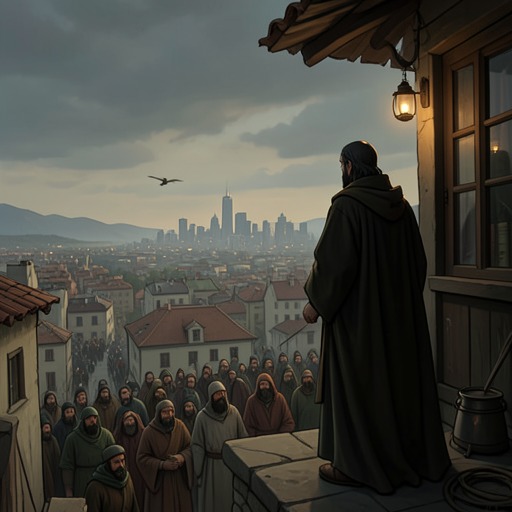
After this exchange, Almustafa descends the steps of the Temple of Orphalese, and all the people follow him. He reaches his ship and stands upon its deck. From there he faces the people once more and announces that the wind bids him leave. The sequence carries him from the Temple, down among the people, and finally onto the vessel; even at the threshold of departure, he turns back toward those who have followed.
Narrative Role and Significance
Almustafa’s departure gives the narrative a clear frame: a long-awaited ship brings his stay in Orphalese to an end, and the final movement carries him from the city’s sacred gathering place to the deck of the ship. The people’s following him links his spoken presence to the physical act of leaving. The scene does not erase that bond; it makes the farewell visible as he boards and addresses them again.
His reply to Almitra provides a final measure of his relationship to speech. The one described as a dawn and addressed as a prophet does not claim to have been only the source of what was said. By including listening in his account of the encounter, Almustafa leaves the people with an image of exchange rather than solitary authority. His return home remains the immediate consequence of the ship’s arrival, while the final scene preserves the mutual presence of speaker and listeners at the moment of separation.